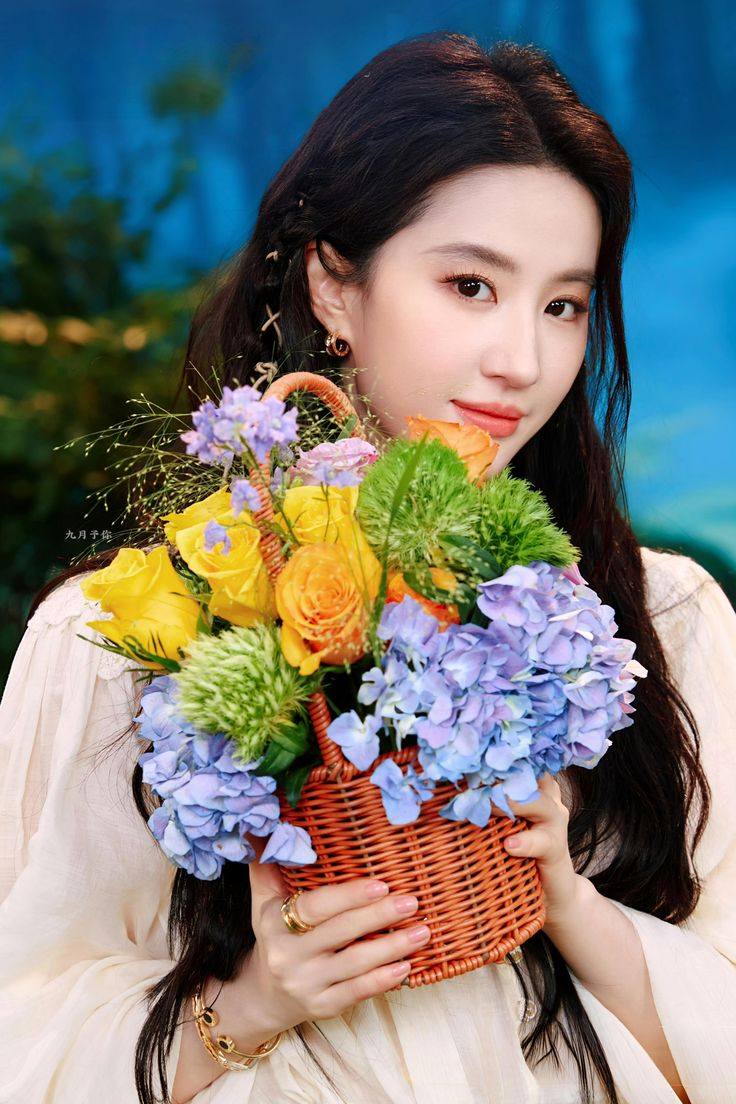


There is a quiet kind of love that doesn’t demand attention, doesn’t shout to be seen, and doesn’t try to prove itself to the world. It simply exists—gentle, patient, and real. That is the kind of love that comes to mind when thinking of Love me for you. A love that asks for nothing but sincerity. A love that feels like looking into the calm, graceful presence of Liu Yifei, whose beauty has always seemed to come from somewhere deeper than appearance alone.
In a world where love is often measured by grand gestures and loud declarations, this kind of love feels rare. It whispers instead of shouts. It lingers instead of rushes. It doesn’t try to change who you are, but embraces every quiet detail that makes you, you. To love someone for themselves is perhaps the purest form of affection—unfiltered, unpolished, and completely honest.
Liu Yifei has long been admired not only for her stunning visuals but for her calm and almost ethereal aura. There is something about her presence that feels effortless, as if she carries a story within her eyes that doesn’t need words. That same feeling echoes in the idea of loving someone not for how they appear to the world, but for how they feel in the silence—in the spaces where no one else is looking.
“Love me for you” is not a plea; it is a quiet understanding. It means: don’t love me because I fit a perfect image, or because I meet expectations. Don’t love me because it’s easy or convenient. Love me because something in me speaks to something in you. Love me because when you see me, you feel at peace—not because I’m flawless, but because I’m real.
There is a softness in that kind of connection, like sunlight filtering through curtains in the early morning. It doesn’t overwhelm—it comforts. It reminds you that love doesn’t have to be complicated to be meaningful. Sometimes, it’s found in the smallest moments: a shared glance, a gentle smile, a quiet presence that says, “I’m here.”
Just like Liu Yifei’s timeless elegance, this love doesn’t fade with time. It grows stronger in its stillness. It becomes something you return to, again and again, because it feels safe. Because it feels true. It’s not about perfection—it’s about acceptance. Not about impressing—but about understanding.
To be loved this way is to be seen without fear. To know that someone looks at you and doesn’t wish to change a thing. They don’t compare you to others. They don’t ask you to become more or less. They simply stand beside you, appreciating your presence as it is. And in that acceptance, something beautiful happens—you begin to love yourself more, too.
Maybe that’s the real meaning behind it all. “Love me for you” isn’t just about the other person. It’s about connection. It’s about finding someone who chooses you not out of need, but out of genuine feeling. Someone who sees your soul, not just your surface.
And in that quiet, gentle love, you realize something powerful:
The most beautiful kind of love is the one that feels like home.